Written by TheChoujinVirus
Note: The following review may contain spoilers to the game
Happy Thursday everyone, it’s ya boy Choujin here.
Not too long ago, I overheard about the Pixel Remaster release of Final Fantasy 1 through 6; it got me feeling nostalgic for my first introduction to the final fantasy remakes. Of course, the first game to be re-released was Final Fantasy and Final Fantasy II (and we mean the actual Final Fantasy II, not Final Fantasy IV that was released in the US years ago.) First, we had Final Fantasy Origins for the Playstation in 2002. Though that game is not our focus. Released on July 29th of 2004 and later on November 29th in North America and December 9th in Europe in the same year. This game is Final Fantasy 1&2: Dawn of Souls. This version improved the original Origins and would later be the source material for future portable remakes of the game series. Does this game stand over its predecessor and the Pixel Remastered successors? Well, one way is to find out…
Brief Story Summary
Final Fantasy 1 and 2 cover two different games, but none are tied to one another. In the first Final Fantasy, the world is plagued by the four fiends that throw the elements of Earth, Fire, Wind, and Water into total Chaos. Your group is four warriors of light, each holding a shard of crystal and tasked with defeating the fiends, reigniting the crystals, and defeating the source of the problem in the world.
Final Fantasy II has you play a band of four heroes: Firion, Maria, Guy, and Leon. They are tasked with joining a rebel army to defeat a villain known as Emperor Mateus Palmecia by braving the world riddled with monsters, Empire soldiers, and various other missions to free the world of this deranged king. Along the way, you gain assistance from others like Joseph, who helps you secure Mithril for the Rebellion, Leila, the pirate who gives you a ship to sail the seas, and Minwu, who helps you unlock the most potent spell in the world.
Gameplay summary

Both 1 and 2 behave vastly differently from each other, but the core concepts are the same. You control a band of four characters as you head from one part of the world to another dealing with monsters that arrive. In Final Fantasy 1, at the start of the game, you’re given a choice of six classes to fill your party of four. You have the heavily armored Warrior, the nimble thief, the iron-fisted Monk, the destructive Black Mage, the helpful white mage, and the versatile Red mage. Each one provides something to the group. For example, Warriors provide heavy protection and attacks, White Mages can provide healing spells, Black Mages can use offensive spells, and Thieves can increase the chances of finding items after fights and more preemptive strikes. Each class has its strengths and weaknesses. For example, the Red Mage (and Red Wizard) can learn both White and Black magic but cannot learn the most potent White and Black magic. The Monk (and Master) has the most substantial attack power in the game, but it cannot benefit from reliable equipment and has a low Hit-Point growth meaning it’s a glass cannon. With a limit of four, you can’t choose all of them. Therefore, your choices matter as you can’t change classes when done. So be careful if you want to go with four white mages. Final Fantasy 2, on the other hand, doesn’t rely on building your part as you start out with three (initially four) members. Though as the first game has you choose classes of your specialty, the heroes of Final Fantasy 2, on the other hand, don’t need to have it. Instead, it ops in using Dynamic Leveling (which requires proficient stats to level up your character.) For example, repetitive use of spellcasting will enhance your spell’s proficiency and the stat associated with the spell and the Magic Point (MP) pool. The same with taking blows may enhance your HP and defenses. In a way, the game encourages you to build up your character’s skills by fighting monsters before progressing (which is helpful in Final Fantasy 2).
Combat in both games is similar. You wander the dungeon or open-world until a random encounter occurs. Your party must defeat the enemy through melee attacks, spells, or item usage to beat your foes, or you get killed (either by wipe or stuff like Stone). Once you’ve defeated your enemies, you gain experience (numbered or dynamic), and sometimes you can get some items and spellbooks. That’s right, in both games, you learn spells through buying spellbooks for your casters. Final Fantasy 1 has you buying up to 3 spells per spell level (it’s complex), but the White, Black, and Red can learn up to three spells from their schools of magic. If you want to learn that spell of that category, you’re going to have to drop a spell if you reach that limit. Final Fantasy 2 has a unique means as anyone can learn spells from white or black magic. Though each attack uses a specific stat (Black uses Intelligence and White uses Spirit). They also start at level 1 but become stronger the more they’re used as they level up. By battling and combatting the enemies, your party will become strong enough to deal with the big bad evil guys at the end of each game and eventually save the world.
Fantastic Heroics: What makes the game awesome.
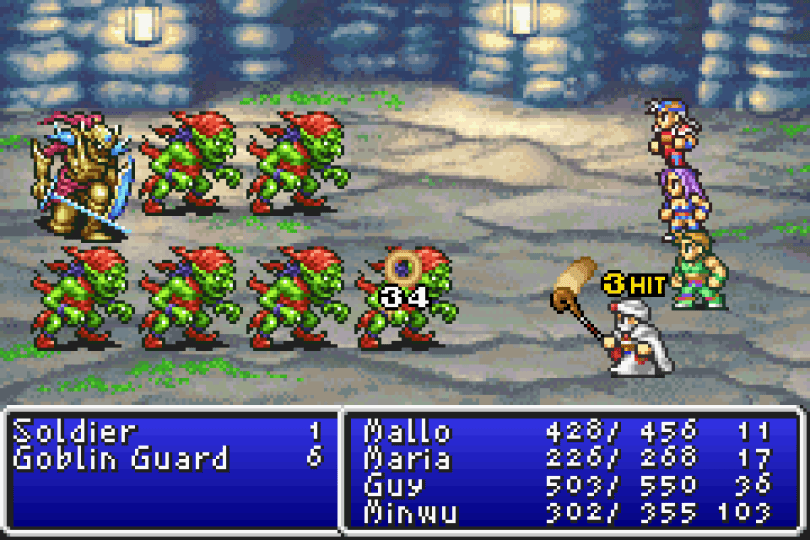
Final Fantasy 1 and 2 have some beautiful features that make the game likable and enjoyable. The first thing is that the games are faithful remakes of the original game. The GBA version is an impressive remake that follows a version similar to the Wonderswan Color for those who grew up with the original Final Fantasy. Updating the game’s graphics to something to their 8-bit counterparts. Another thing is that the game introduces bonus content into the series. In the first Final Fantasy game, after defeating Tiamat, you have the side mission of exploring the Bonus Dungeons (named Soul of Chaos in the PSP version), which have you exploring four bonus dungeons for rare loot and potent weapons by fighting monsters. Best of all, the monsters are bosses from later games such as the Echidna from Final Fantasy 3 in the Earthgift Shrine, Scarmilione in the Hellfire Chasm, Gilgamesh in the Lifespring Grotto, and Ultros in Wisperwind Cave. A very excellent introduction to new players to future bosses and an old throwback to veterans who played the games.
Final Fantasy 2’s bonus content is a xenologue called Soul of Rebirth, which continues a side story of Minwu, Josef, Scott, and Ricard as they solve a mystery of why they’re in the land of the dead and why they were all brought here. It’s a beautiful part that gives some plot about what happened to them later in the story.
Lastly, the game’s music is impressive for something handheld on the GBA, as the remix music does have a bit better than what one could find in the first version. Hearing the remix of the Four Fiends fight, or even Palmecia’s final battle theme, is very impressive and something one might not expect to see from the game’s simple quality.
Total Party Wipe: What is the game’s problem

Though Dawn of Souls has some great features, some problems make the game slightly unfun. For both veteran and new players, the spell system in Final Fantasy seems a bit outdated and a handful. For example, as a White Mage, to heal specific spell statuses, you have to learn said specific spell to purge things like poison, silence, and Stone. Though Final Fantasy 2 gives us the magic Esuna that can cure all status conditions. The limited spell slot in 1 makes the game oh so complex and cumbersome.
Another problem is found in 2’s Dynamic Leveling system. The system is creative and innovative, but it’s a huge pain. To become proficient in a weapon, you have to constantly keep using it (including shields), which can be a pain if you want to be a weapon master. Learning new spells is the same, too, as all newly discovered spells start at level 1. This is a pain when you find some of the most potent spells like Flare, Holy, and Ultima, as you have to fight monsters just to make them up to snuff.
Lastly, though basically fun, the game doesn’t have any kind of guidance that future games introduce. It’s easy to get lost without a guide. In the first game, you are only guided to Garland in the Chaos Shrine, and afterward, you’re given full exploration later in the game, which, while good, can be a pain as some core aspects may require you to know. One such is the trials to unlock your party’s class upgrade, which can be forgotten unless you look it up. Final Fantasy 2’s content isn’t that problematic as the game does provide you a hint of where to go and where to progress. It’s not that bad, but still, you may need a guide to figure out situations.
Fun Easter Egg
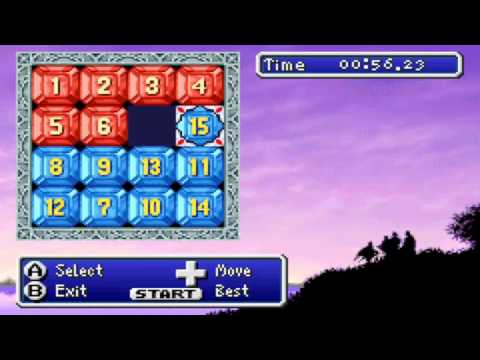
In Both games, there’s a tiny easter egg that one can enjoy: Two minigames are found in each game.
The first game is a slider puzzle in Final Fantasy 1. Hold A, then Press B 23 times while aboard your boat, and you’ll unlock a sliding puzzle. Completing the puzzle at specific times will reward you with random items in your inventory, so it’s a fun game.
The second game is found in Final Fantasy 2. While in the snow craft, hold A, then press B 22 times, and you’ll unlock a memory game. Complete it with minimal misses, and you can claim some good items. Also, if any of your members have learned the Toad spell, you can unlock a variant of the same memory game but with toads. Completing those will reward you with equipment instead of items.
Verdict, is it worth it?
Final Fantasy 1&2 Dawn of Souls is a decent game (and for those who want to play the game but have no access to a GBA, the closest is the PSP version is viable as it’s viable to access due to having the same content and then some. However, if you want to play a game for a portable like the GBA, this game is the go-to. Is it better than Pixel Remasters? In ya boy’s opinion? Yes.
References
Nintendo’s official Final Fantasy 1&2 Player’s guide
GBA commercial trailer uploaded by IGN

 Absolution's Archive