Review written by TheChoujinVirus
Note: This review contains spoilers to the game, so if you don’t want to be spoiled, do not read the review.I have some chat connections with the creator of the game, T.F. Wright. However, the review is done out of my own honest opinion. In no way am I being influenced by the creator.
Happy Thursday everyone, It’s ya boy Choujin.
When one thinks of the genre of Urban Fantasy, they automatically assume the typical groups: Twilight, Harry Potter, and the such. Some may think of things like Life is Strange if needed when it comes to the genre. Now your boy isn’t fond of the whole aspect of the genre (mostly thanks to Twilight), but I’m not afraid of trying it if it’s okay. Hence today’s review of a game that came out a week ago on the Steam store. The game’s called Wicked Willow, written and made by T.F. Wright (the same creator who made The Pirate’s Fate. I’ve also did a review of the game here if you’re curious of my review. Though unlike the last game, there are no furries in this story. So how is this visual novel? Well, let’s get started on my review of Wicked Willow.
Story Summary
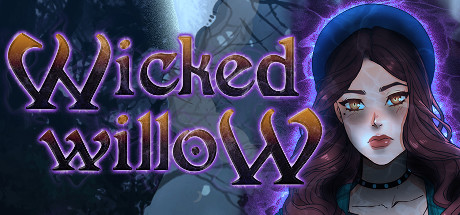
In Wicked Willow, you play Willow, a 20-year-old college student and aspiring writer in a 1993 American city. One day, after chasing a strange black cat, she is attacked by a mass murder named The Axeman. She kills the guy by accident through her newly discovered powers. The cat she was chasing reveals he can talk and is named Shadow. He explains to Willow that she has a magical gift and that his job is to bring her to Tanya, the woman seeking out Willow. The old witch serves as Willow’s mentor throughout this whole crazy journey. And boy is it one crazy journey, from a bank robbery to loggers, to outright dealing with being Jumanji’d into a tabletop game and outright coping with the end of the world. Willow doesn’t go through this odd and bizarre adventure on her own as she runs into some colorful characters. Besides her mentor Tanya, the Serbian witch who knows a lot about our protagonist, you have the talking cat Willow, Willow’s closest friend Avery. You also have antagonists like Lydia, the very religious southern girl who looks like the poster child for the 700 Club and Xarsi, the succubus who seems to have a one-tracked mind. Now the game, for any visual novel, usually has paths and choices that affect what happens next in the story. Though beware, as Tanya explained that the use of magic has consequences, you could stop robbers by turning their bullets to flowers, saving someone but causing somebody else to suffer. Do you want to help the suffering person recover? Sure, you can save their life, but how much is to spare the life of a person? Maybe you shouldn’t use magic at all and try and solve it without magic? Whatever choice you make has a consequence for Willow, her friends, or even everyone around them. However, if they call you wicked due to the choices you make? Then so be it…
Wicked Wonders: What the game shines in
There’s plenty of positive choices in Wicked Willow, but I’ll try and name some preferences. One is the characters. Though the protagonist isn’t a tabula rasa like Mila from The Pirate’s Fate, Willow has her personality that makes her organic. In most games where you choose the outcome, it usually shapes the protagonist’s personality and world. Willow’s perspective and base personality don’t change to where she wants to punch someone, but she tries to fix mistakes. It’s not only limited to her; the supporting cast of the entire group is pretty great as well as each does have their quirks and strengths that make them stand out. It’s also done well by a great voice acting cast that brings the characters to life. Usually, it’s pretty rare to see voice acting in visual novels, but it’s pretty stellar. My personal favorite voice is the VA for Shadow the cat. I find it awesome how an older voice coming from a small cat can make a character interesting. I also like how every character you meet has a backstory that you can empathize with. (Some of them are pretty tragic.) For example, the villainous Xarsi is revealed to be once a nun who was devout but became a succubus out of desperation out of a frail old age. Another that was shocking was Lydia, who is a survivor of conversion therapy and that she was a closet lesbian. (It’s also revealed her Anti-Magic powers surfaced during these horrendous conditions.) In short, the villains in this story feels morally challenging (as it should be.) What I like also is the style and research. T.F. Wright did some homework on some of the stuff, as the story takes place not just during 1993 but also during a landmark moment known as Baehr vs. Miike, in which Hawaii legalized same-sex marriage. You see hints about Hawaii throughout the story (Blue Hawaiian, the flowers used to thwart the robbers.) It’s an exciting and subtle nod to this moment and something that fits the motif and several factors.
Finally, what I like about this is how they portray the romances, regardless of whom you choose to romance. They feel organic and not hasty corny, especially for same-sex romance options. Usually, my experience with stories involving same-sex romances kind of feels cringy (like bad anime level of cringe.) However, I do like how T.F. Wright’s writes these romances. The Final praise I like is the checkpoint system. In most V.N.s, you have to save at major choices then come back to it. Wicked Willow fixes this by creating a checkpoint system that lets you go back and check a new path; thus, you don’t need to create multiple save states during choices. Pretty good if I do say so myself.
Magical Flops: What the game lacks.
Though Wicked Willow had plenty of perks that made the series great, there were some issues that kinda made me feel a bit like they were lacking. First, I’d have to say is that though the backstories for each character are great, they are locked behind the romance paths. I wouldn’t mind learning of Avery’s secret during the Lydia path (it would explain how he figured out about Lydia’s secret.) Also, some characters on some paths are outright ignored, leaving some moments wondering what happened to said character while on this path. Another that makes me feel a bit griped is the endings. One is that there are a bit fewer endings than the usual, but that can be viewed as a compromised with the voice acting, but what kinda makes me feel a bit odd is how that there isn’t any negative ending (save for the world ending and having to reset the timeline) and that the conclusions you seem to go through, somehow doesn’t feel grim. (not total grim dark like how The Pirate’s Fate and their endings are.) Though some might view the Groundhog’s Day time-loop, Willow goes through as a repetitive bad ending (though some of them do give hints on what to do next or clues for a golden ending.) That kind of hurts replayability once you figure out the endings and secrets that are in the game. This gets to my last moment that though the basis of the game is excellent, it feels a bit short and not many secrets or mysteries to answer.
Hawaiian Conclusion
Despite the shortcomings of Wicked Willow, I find the series very nice and detailed. As I stated before, I wasn’t a fan of the Urban Fantasy genre, but I found Wicked Willow to be an excellent take at the genre.
The cast of characters, the voice acting and the quality of life make the game entertaining. It’s also great to see T.F. making more of these V.N.s and that his game got some excellent praises on Steam. Hopefully, he makes more games or V.N.s in the future.
 Absolution's Archive